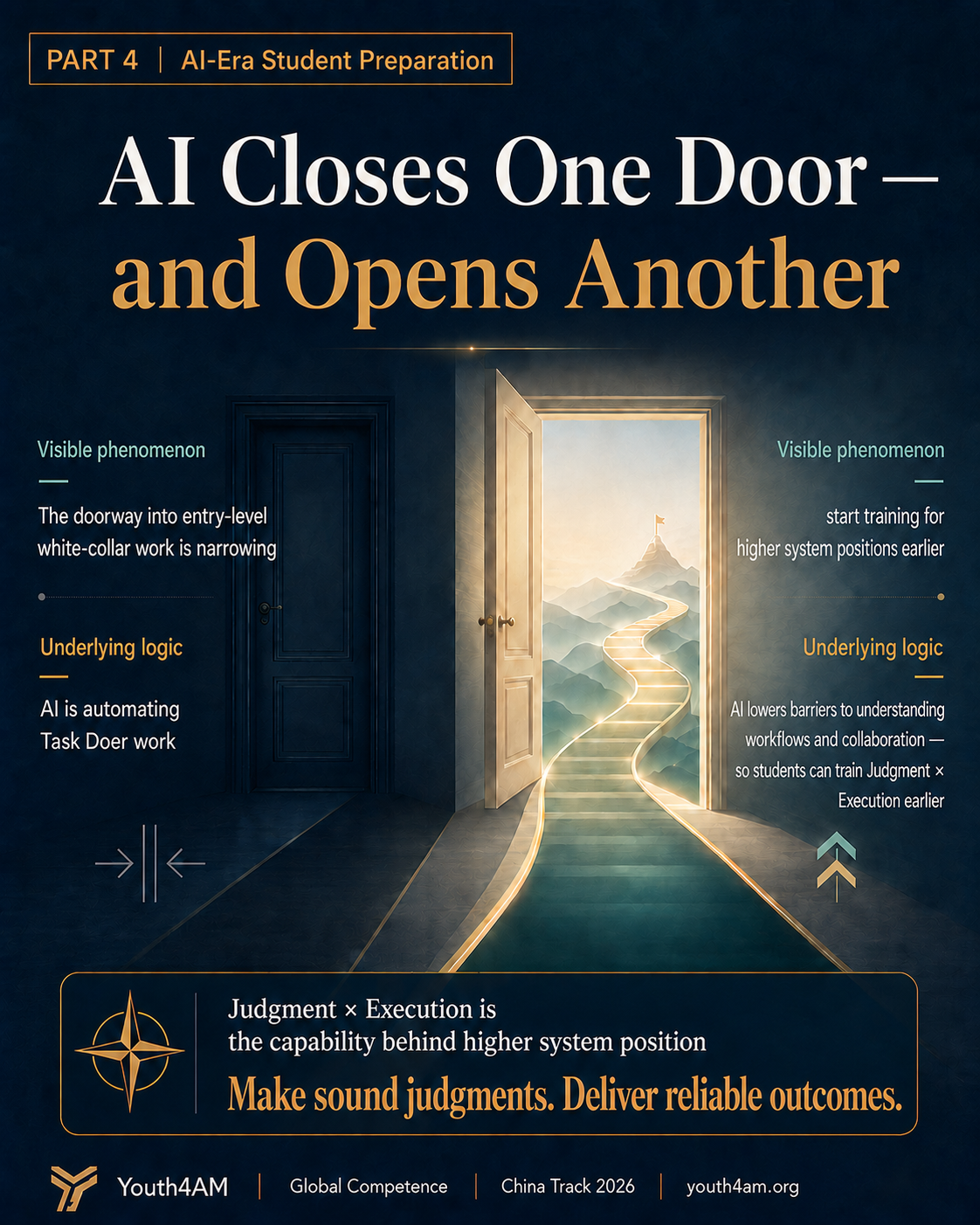
AI Is Closing One Door — and Opening Another
The deeper answer is not simply a safer major or more AI tools. Students need to train Judgment x Execution earlier and move toward higher system positions.
AI is narrowing the traditional entry-level white-collar pathway. But "entry-level" is only the surface label. The deeper mechanism is that AI is automating a large share of defined, standardized, repeatable Task Doer work — work that mainly depends on Knowledge x Skill.
The real question is not whether students can skip years of experience. They cannot. The real question is whether students can begin training the capability patterns that higher system positions require earlier.
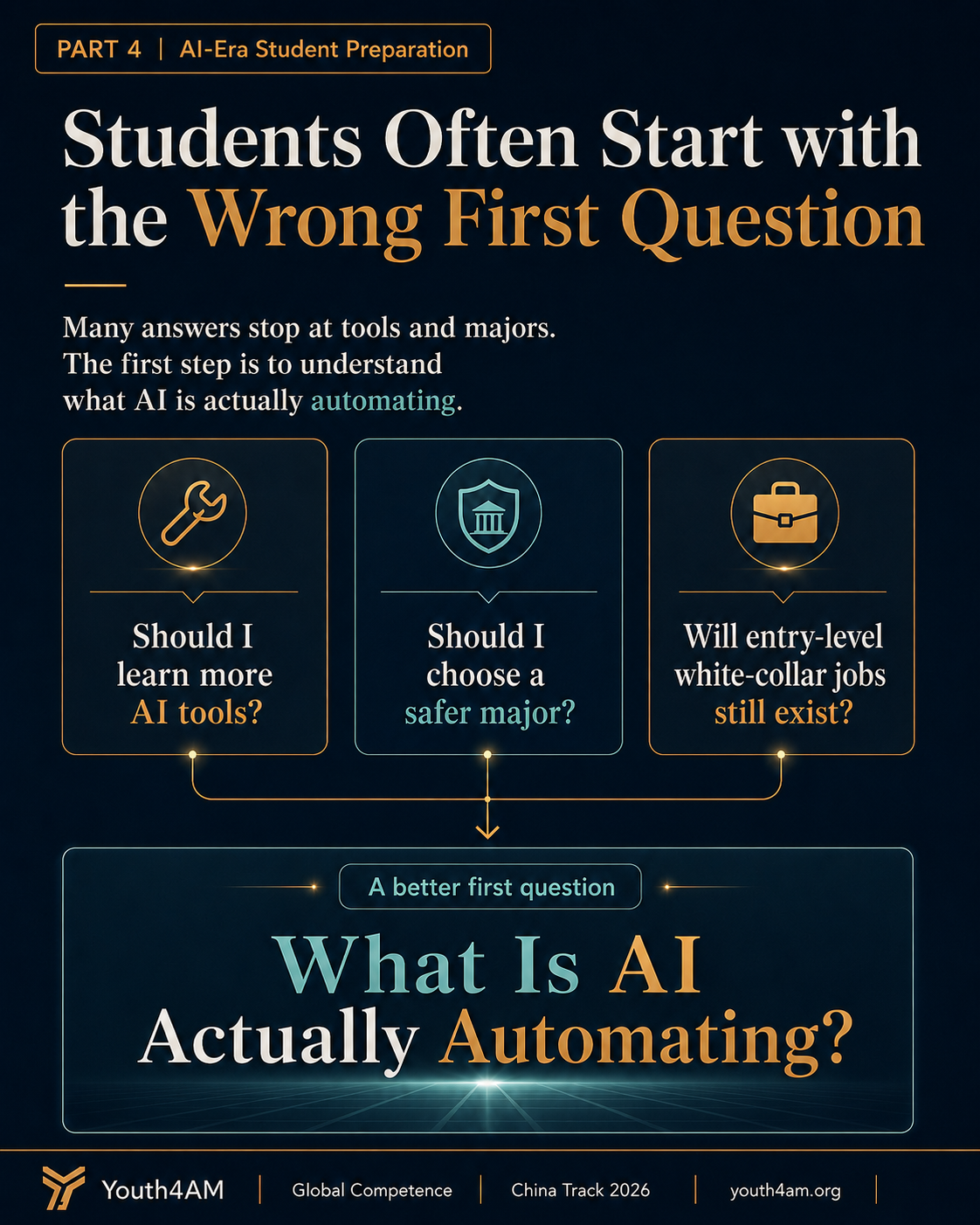
The Better First Question: What Is AI Actually Automating?
When students and parents feel pressure from AI, the natural questions are understandable:
- Should I learn more AI tools?
- Should I choose a safer major?
- Will entry-level white-collar jobs still exist?
These questions matter. But they are not the first questions.
The better first question is:
If we do not answer that question clearly, the rest of the discussion becomes distorted. Students may chase tools without knowing what problem they are solving. Families may choose majors defensively without understanding what kind of work is becoming more exposed. Schools may offer more content without training the capabilities students actually need.
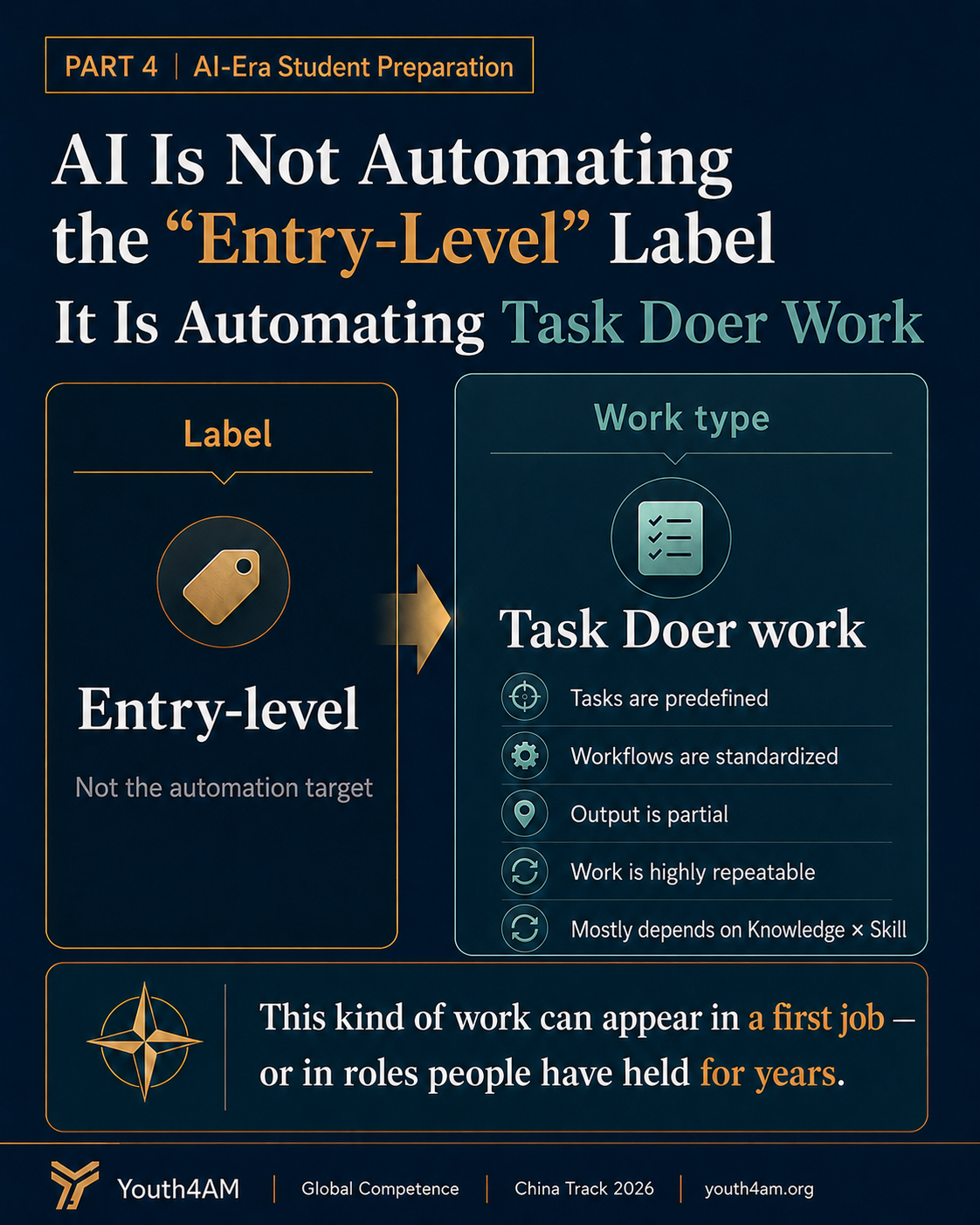
AI Is Automating Task Doer Work, Not the "Entry-Level" Label
A common way to describe the problem is to say that AI is automating entry-level jobs.
That is not precise enough.
AI is not automating "entry-level" as a label. It is automating a type of work: Task Doer work.
Task Doer work usually has several features:
- The task is already defined.
- The process is relatively standardized.
- The output is local or partial.
- The work is repeatable.
- Success mainly depends on Knowledge x Skill.
This matters because many entry-level white-collar roles historically contained a high share of Task Doer work. Students entered organizations by completing defined tasks, gaining exposure to workflows, and gradually learning how larger systems worked.
That is why many entry-level pathways are exposed to AI.
Not because young people have no value, but because much of the work they used to do to enter organizations can now be generated, assisted, accelerated, or replaced by AI.
This does not only affect young workers. Task Doer work can appear in a first job, but it can also appear in roles people have held for years. Anyone whose value remains mainly in completing repeatable, defined, standardized tasks is exposed to the same structural pressure.
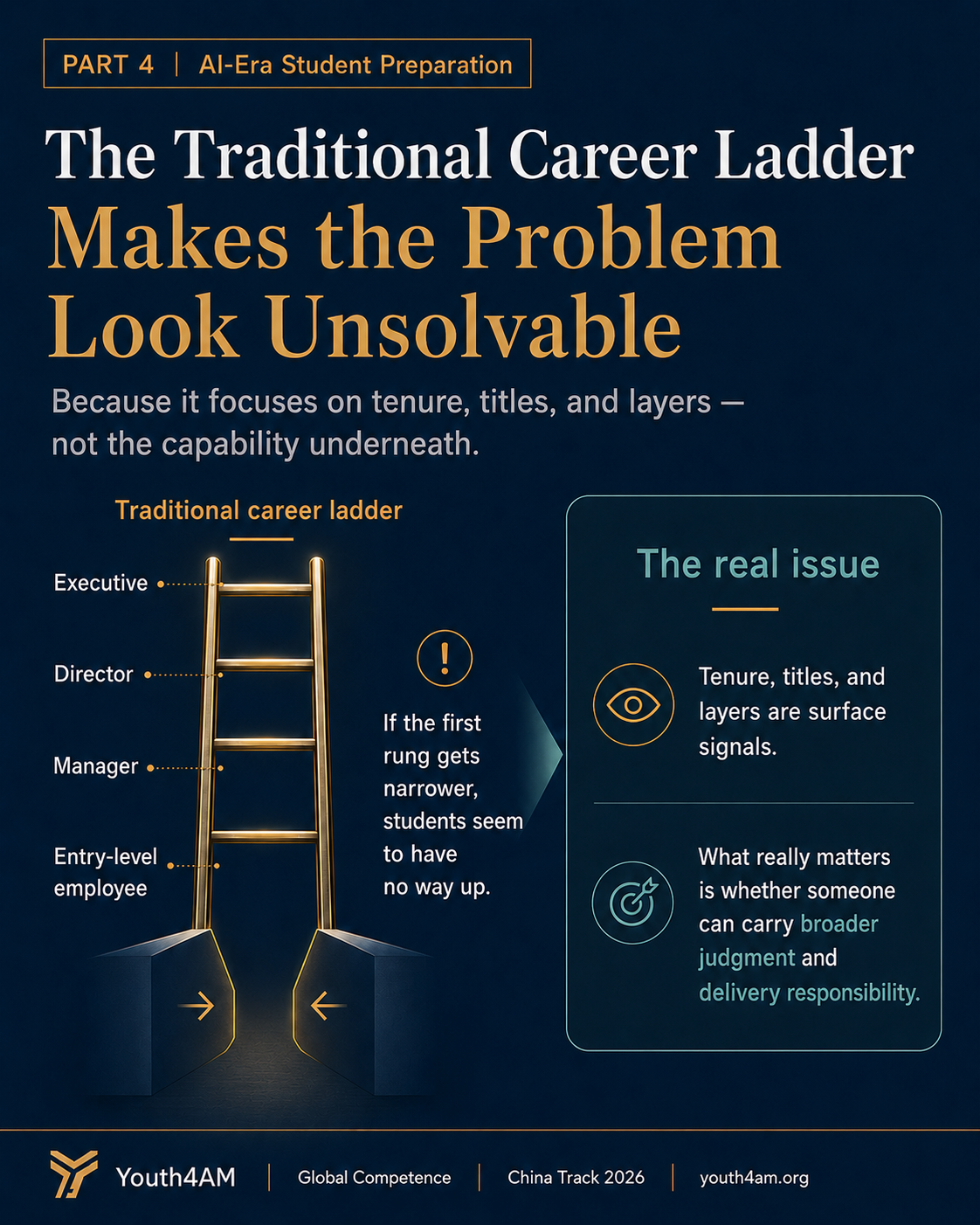
Why the Traditional Career Ladder Makes the Problem Look Unsolvable
This is why the problem can feel so difficult for families.
Most people still picture student growth through a traditional career ladder:
Student → entry-level employee → manager → director → executive
If the first rung becomes narrower, the whole path seems blocked.
The anxiety is logical. Entry-level work used to be the learning ramp. It gave students access to organizations, workflows, managers, colleagues, feedback, and the chance to prove themselves through defined tasks.
If that ramp narrows, families naturally ask:
How can students move upward if they cannot easily enter at the bottom?
But the traditional ladder focuses on visible signals: years, titles, and hierarchy.
Those signals matter, but they are not the underlying capability.
What organizations ultimately want to know is whether someone can take on broader judgment and delivery responsibility.
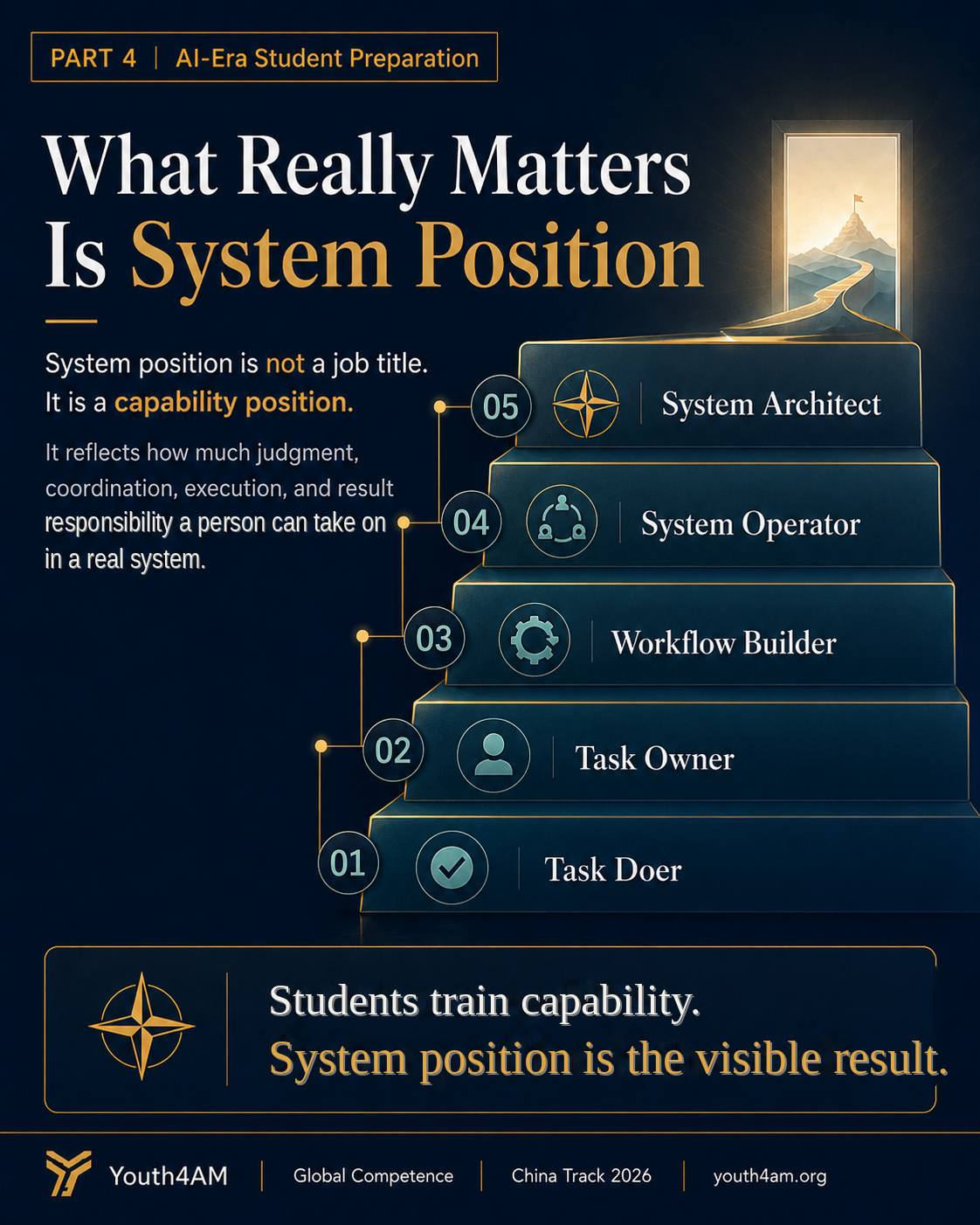
What Really Matters Is System Position
Youth4AM uses the term system position to help students understand this shift.
System position is not a job title. It is a capability position.
It reflects how much judgment, coordination, execution, and result responsibility a person can take on inside a real system.
From lower to higher system position, the path can be understood as:
This is not about pretending that students can skip years of experience. They cannot.
It is about seeing the real capability structure behind experience. Students do not train a position. They train capability. System position is the visible result.
AI Tools Are Leverage, Not Capability Itself
If system position reflects the capability structure behind traditional titles, then moving toward higher system position cannot be solved by a surface change alone.
It is not simply choosing a safer major.
It is not simply learning more AI tools.
Majors still matter. Knowledge still matters. Skills still matter. AI tools also matter.
But they are no longer enough.
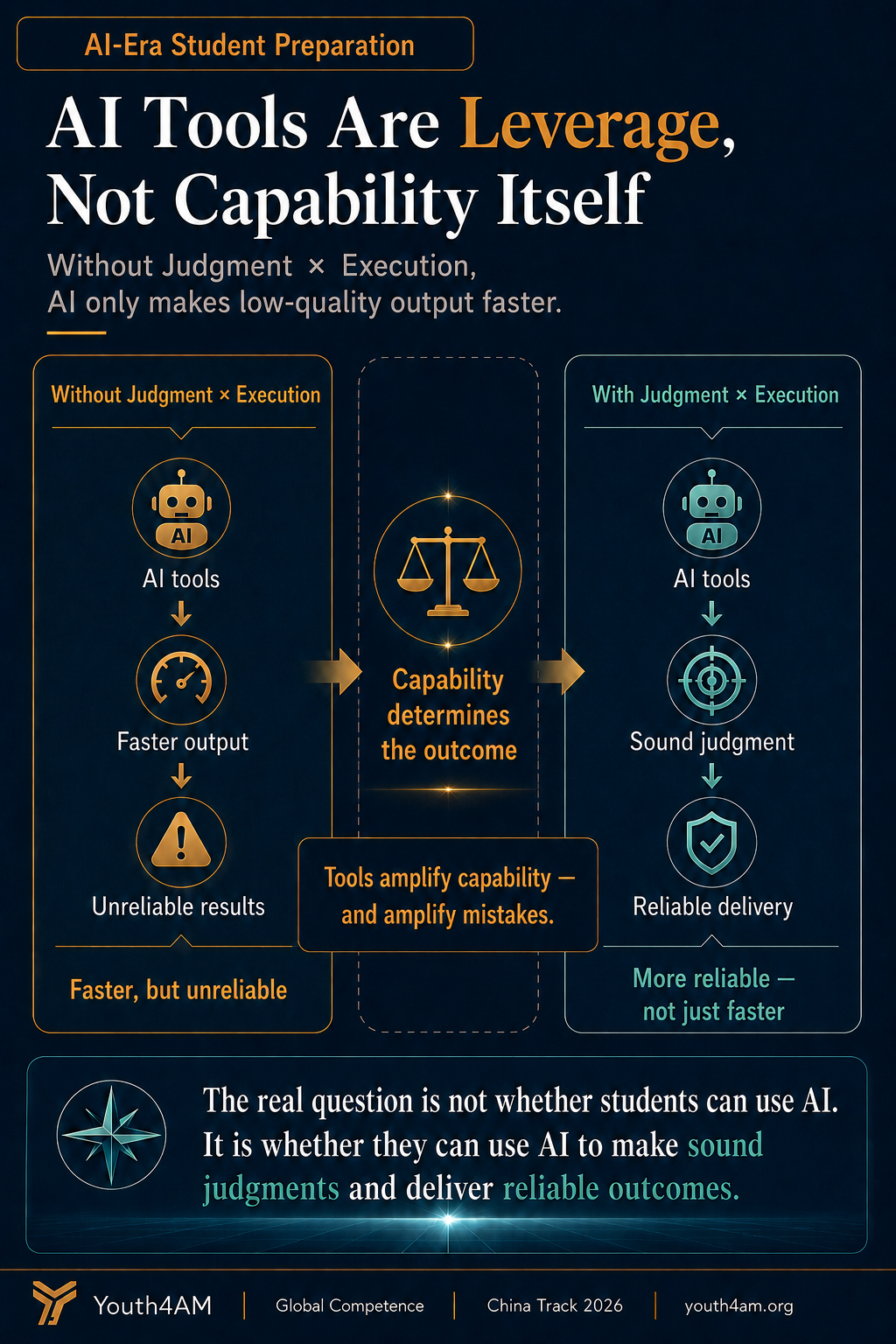
A major mainly gives students knowledge and skill foundations. AI tools mainly help students complete work faster. If a student only uses AI to complete someone else's predefined task more quickly, that student is still operating as a Task Doer.
AI tools are leverage. They can amplify capability, but they can also amplify mistakes.
Without Judgment x Execution, AI can help students produce low-quality output faster.
The real question is not whether students can use AI. It is whether they can use AI to make sound judgments and deliver reliable outcomes.
The Success Formula Is Changing
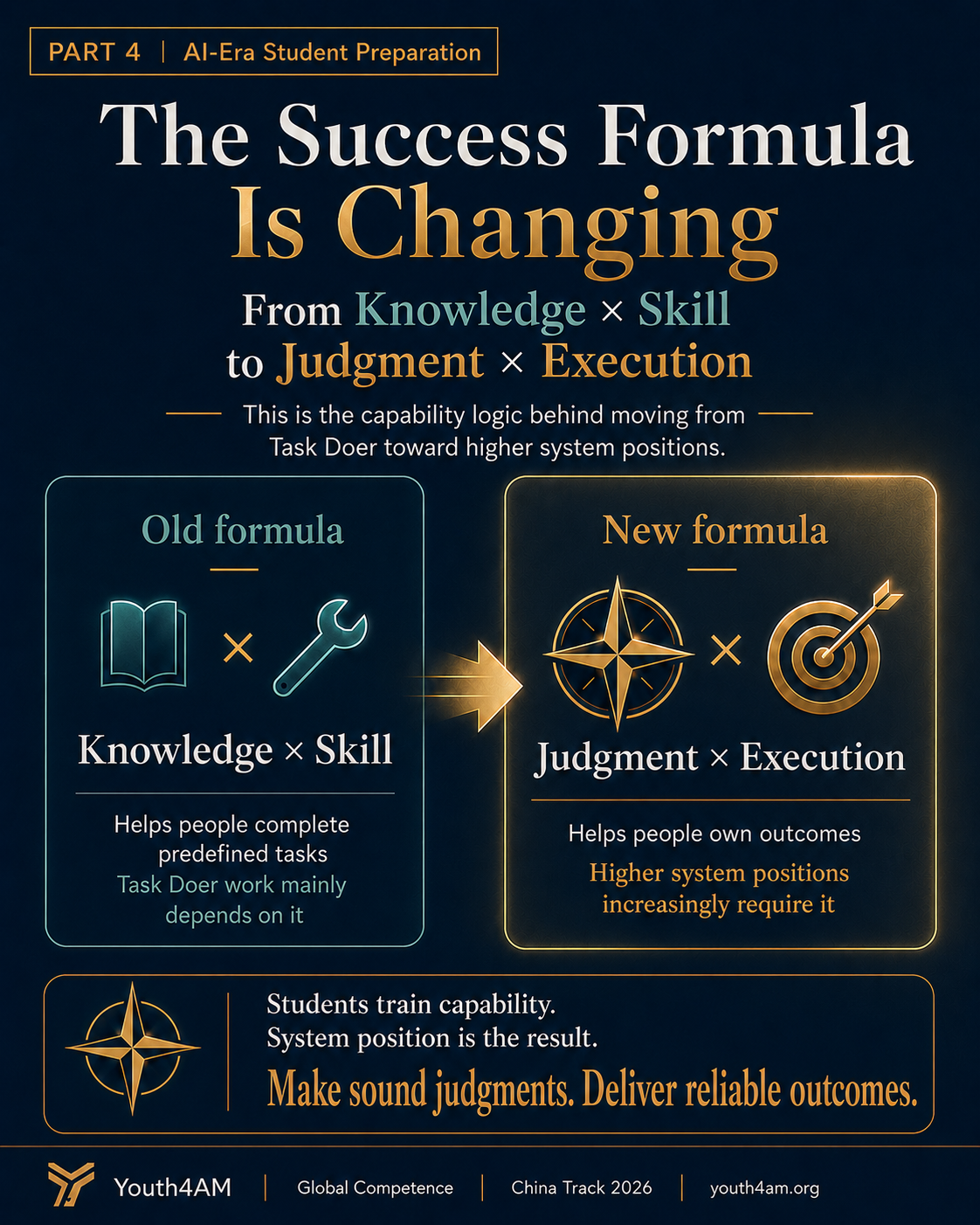
The deeper shift is that the success formula is changing.
Knowledge x Skill helps people complete defined tasks.
Judgment x Execution helps people own outcomes.
This does not mean knowledge and skills are no longer important. They remain essential. But they are no longer sufficient as a durable advantage when AI can increasingly assist with content generation, code generation, basic research, summarization, and routine analysis.
Task Doer work historically depended mainly on Knowledge x Skill because the task was defined by others, the process was relatively standardized, and success meant completing a local output.
But higher system positions require more.
Task Owners need to judge goals, quality standards, and responsibility boundaries. Workflow Builders need to judge how work connects across tasks and handoffs. System Operators need to judge where systems break, how resources should be coordinated, and how results can become more stable.
That is why the shift from Knowledge x Skill to Judgment x Execution is not a separate idea from the shift from Task Doer to higher system position. It is the capability logic behind that shift.
In plain language, students need to learn how to make sound judgments and deliver reliable outcomes.
AI Also Opens a New Training Window
AI is closing part of the old Task Doer entry ramp.
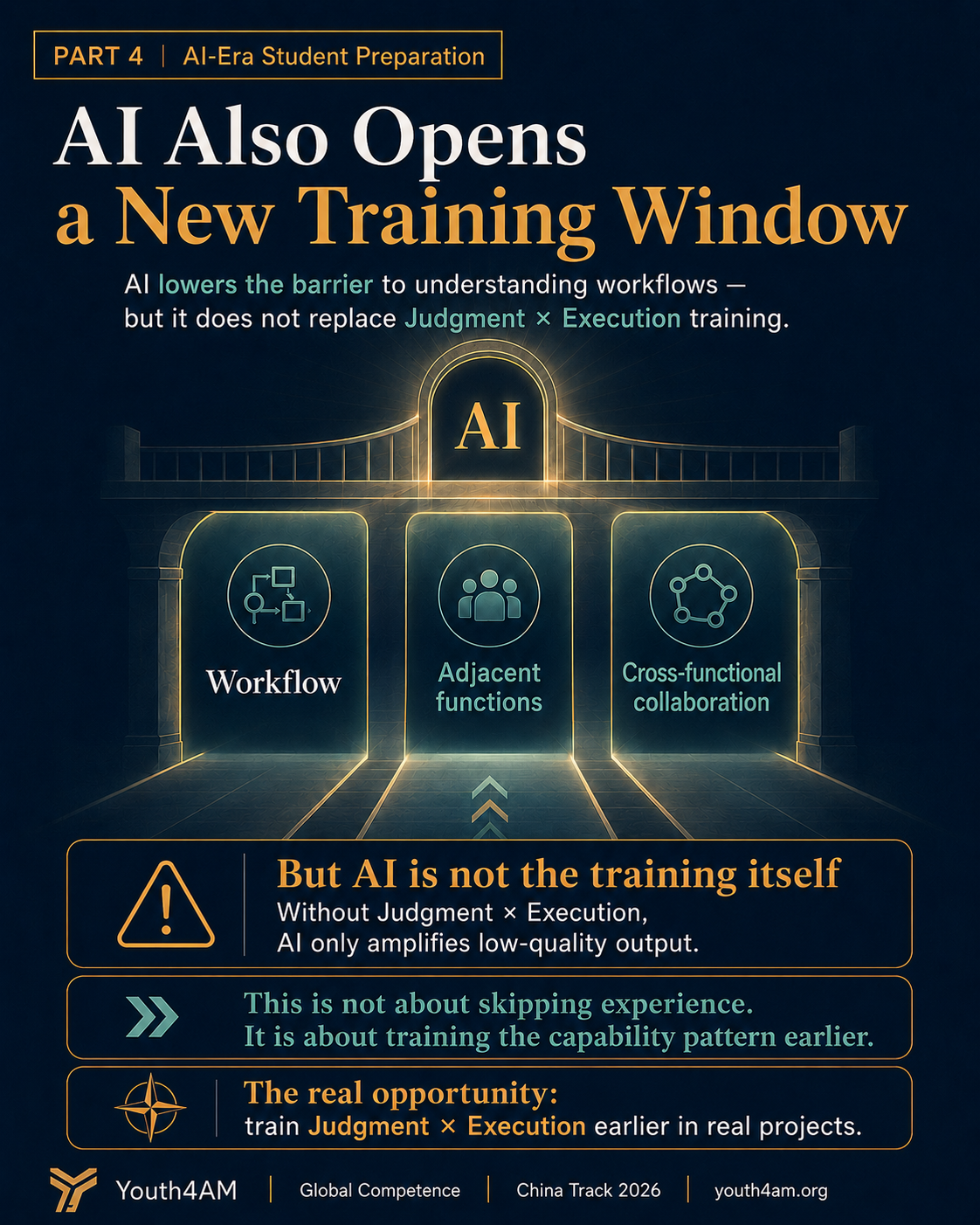
But it also opens a new training window.
Before AI, students often needed years of organizational experience to understand how workflows, adjacent functions, and cross-functional collaboration actually worked. They had to wait for access to real roles before seeing how tasks connected into larger systems.
AI can lower that barrier.
Students can now use AI to explore how an industry works, how a workflow is structured, how different functions connect, and how a project moves from idea to delivery.
But AI is not the training itself.
This is not about skipping experience. Work experience cannot be pretended or artificially compressed into a credential.
The real opportunity is different: students can begin training capability patterns earlier.
With the right training container, AI can help students enter real projects with more context, ask better questions, compare systems, draft and revise outputs, and test their judgment earlier.
Without Judgment x Execution, AI only accelerates weak work. With Judgment x Execution, AI becomes a tool that helps students train higher-quality thinking and more reliable delivery.
Capability Is Trained in Real Projects
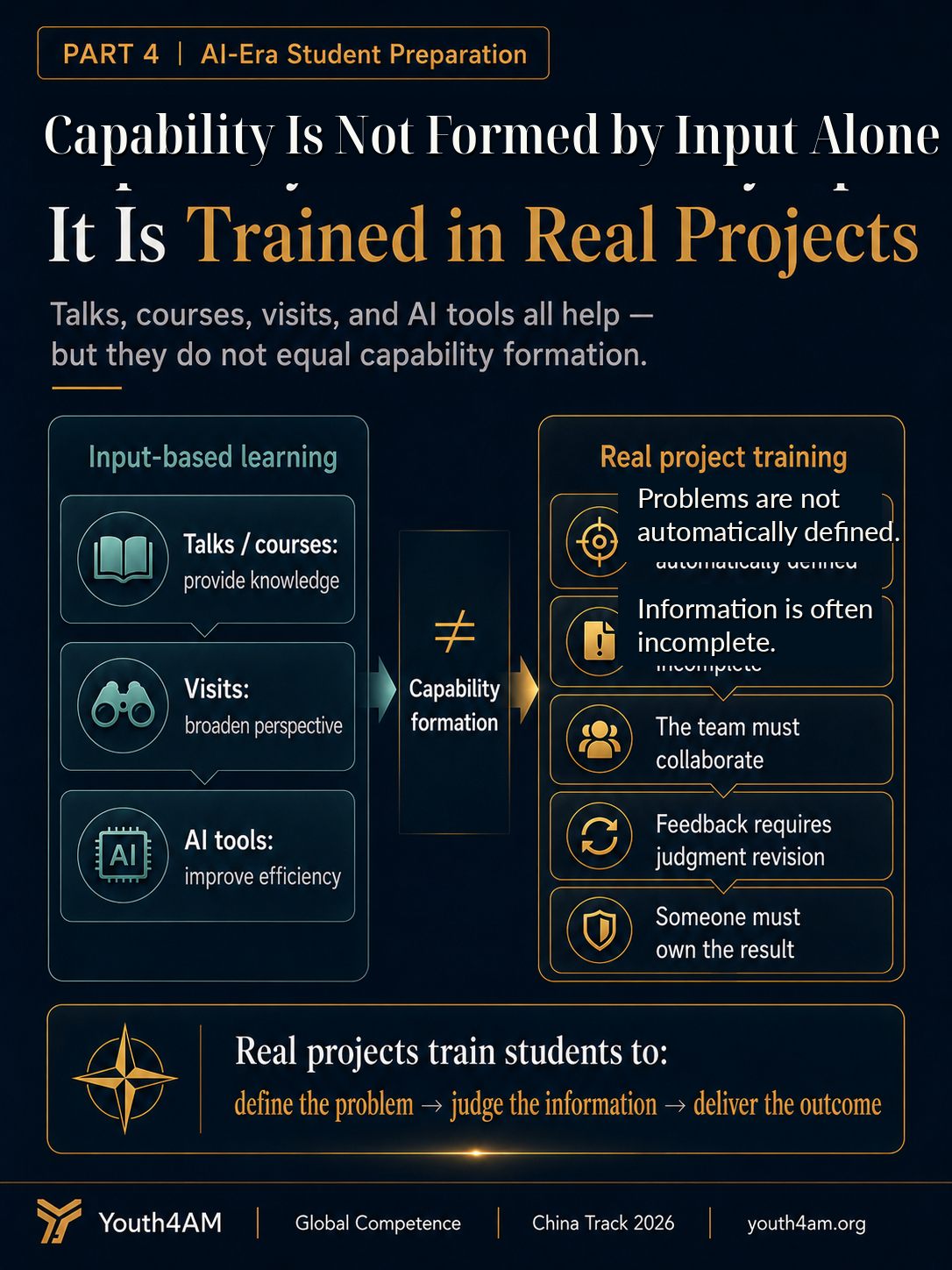
Capability is not formed by input alone.
Talks, courses, visits, and AI tools all help. They can provide knowledge, broaden perspective, and improve efficiency.
But they do not equal capability formation.
Capability forms when students have to act inside real projects:
- The problem is not automatically defined.
- Information is often incomplete.
- The team must collaborate.
- Feedback requires judgment revision.
- Someone must own the result.
This is why real projects matter. Students need to practice defining the problem, judging the information, and delivering the outcome under real constraints.
That is also why a program cannot be evaluated only by how impressive the exposure looks. Exposure does not automatically become capability. Capability forms through training, feedback, revision, and delivery.
What Youth4AM Trains
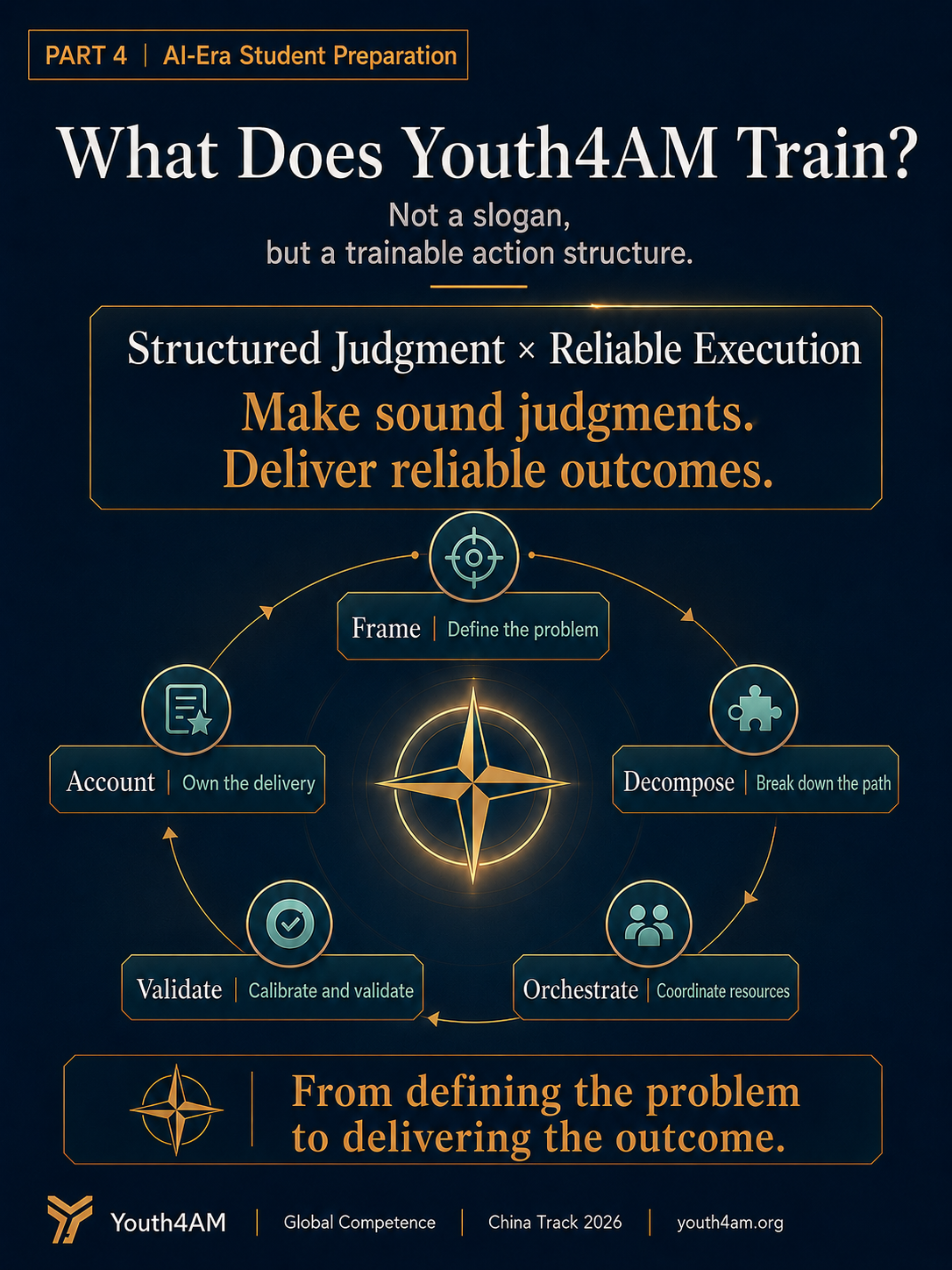
Youth4AM's answer is Structured Judgment x Reliable Execution.
In plain language: make sound judgments and deliver reliable outcomes.
This is not a slogan. It is a trainable action structure.
Students learn to move through five operating actions:
These actions help students move from simply completing tasks toward taking responsibility for outcomes.
That is the capability foundation behind higher system position.
What Students Really Train: Five Practice Patterns
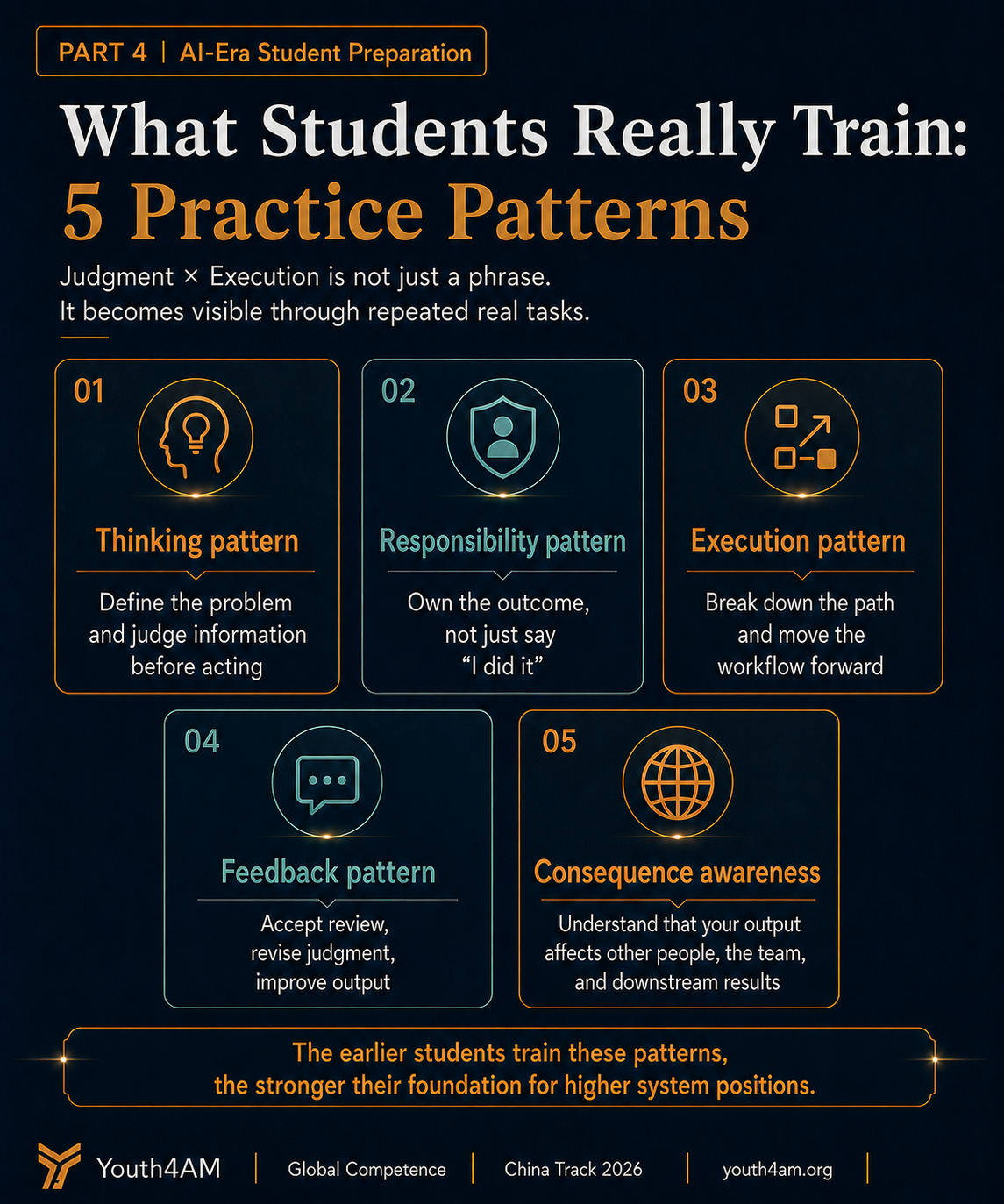
Judgment x Execution becomes visible in repeated real-task behavior.
Students are not only learning concepts. They are practicing patterns:
The earlier students train these patterns, the stronger their foundation for higher system positions.
Why China Track Is the Training Container
This is the logic behind Youth4AM Global Competence | China Track 2026.
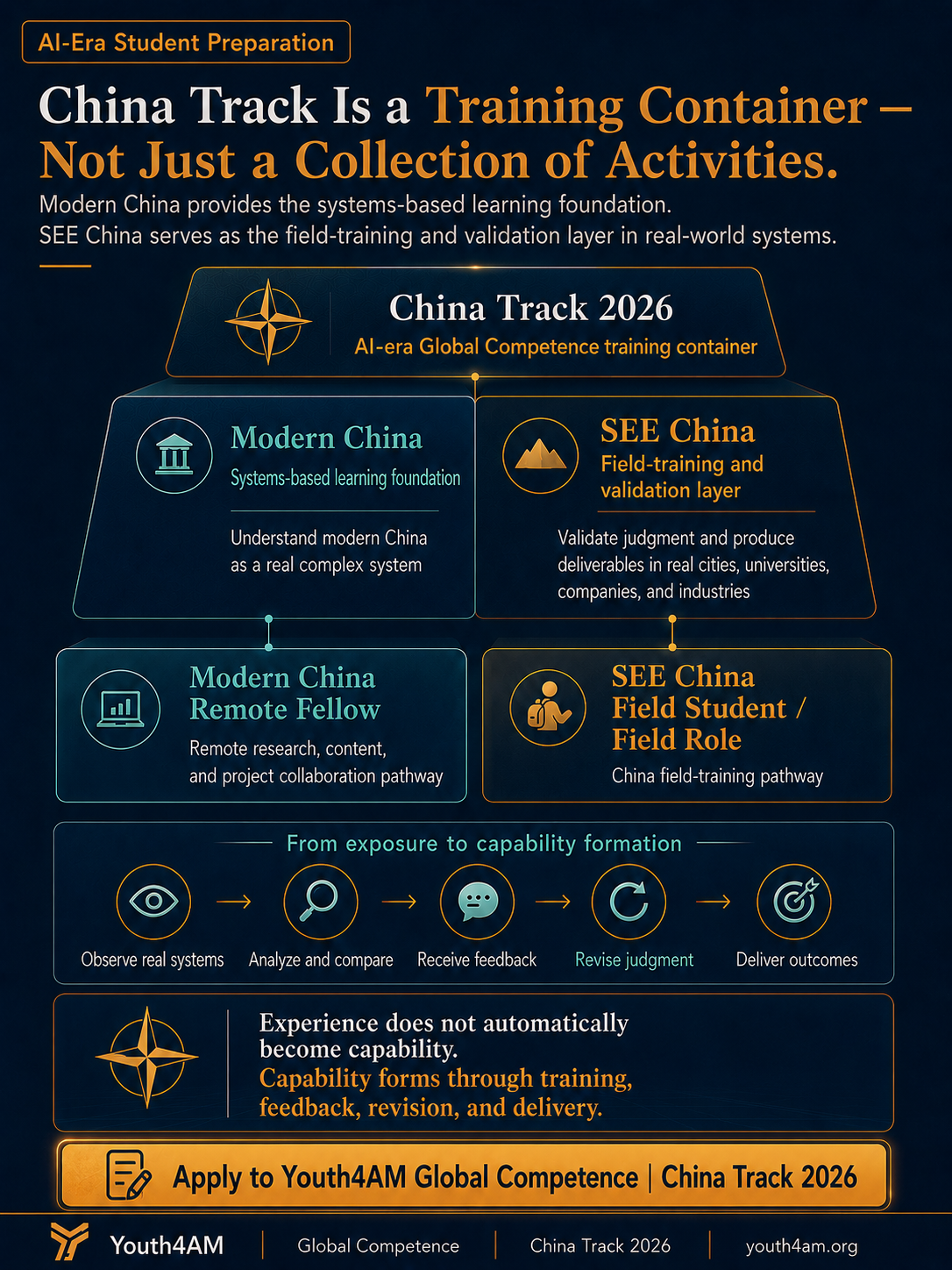
China Track is not a normal activity stack or a simple exposure program. It is a training container.
Together, Modern China and SEE China help students build two things the AI era increasingly demands:
- better understanding of modern China as a competitive advantage;
- the ability to make sound judgments and deliver reliable outcomes across national systems.
This is why China Track is not only about whether a student has been to China.
It is about whether a student can use a real-world system to train judgment, execution, feedback, revision, and delivery.
AI-era student preparation is not just more content, more tools, or more credentials.
It is the formation of capability.
Ready to train for AI-era global competence?
Apply to Youth4AM Global Competence | China Track 2026. Choose your pathway: SEE China Field Student / Field Role or Modern China Remote Fellow.

