Youth4AM — Global Competence | China Track
Modern China
A systems-based curriculum for the Global Competence the AI era demands
Modern China helps students build the Global Competence the AI era demands. It helps students build better understanding of modern China as a strategic knowledge advantage, while developing the AI-era ability to make sound judgments and deliver reliable outcomes across national systems.
Modern China is not a course about language, culture, headlines, or political positioning. Instead, it helps students understand how real systems shape industries, opportunities, and future pathways through comparison, evidence, judgment, and outcomes.
What Modern China Is
Modern China does not treat China as a topic list or a set of facts to memorize. It treats modern China as a complex, observable, and comparable real-world system.
The goal is not to produce conclusions about China. The goal is to help students build better understanding of modern China as a strategic knowledge advantage, while developing the AI-era ability to make sound judgments and deliver reliable outcomes.
When this ability is exercised across national systems, it becomes Global Competence.
Modern China is structured this way for a reason. In the AI era, competition increasingly operates through systems rather than only through isolated individuals. This is true not only at the level of national systems and industries, but also at the level of technology itself: advantage increasingly depends not only on single technical breakthroughs, but on how effectively larger systems integrate technology, capital, talent, infrastructure, and execution.
That is why this course does not study China through headlines or isolated business cases alone. Instead, it trains students to see how national systems, cities, industries, and firms interact — and how those interactions shape outcomes for countries, industries, and most importantly, individual future pathways.
Modern China is built through Youth4AM’s own in-house curriculum design and structured comparison approach.
What Students Study
Students study modern China through structured comparison, especially with the United States, across multiple system levels. Comparison is built into every level of the course.
National Systems
Policy, execution, and state capacity; finance, capital allocation, trade, and system incentives; infrastructure and system interfaces; talent, entrepreneurship, and culture as operating conditions
City Systems
Cities as economic systems; city tiers and differentiated regional roles; inter-city competition and specialization; smart city development and system integration
Clusters and Specialized Markets
How specialization forms inside larger systems through industrial clusters, specialized markets, and city-based concentration of capability and scale
Industry Systems
AI and data infrastructure, semiconductors, robotics, manufacturing and supply chains, digital platforms, healthcare and biotech, mobility, and energy
Firms as Execution Windows
How companies and organizations operate within larger system constraints and turn structure into outcomes
How Modern China Is Taught
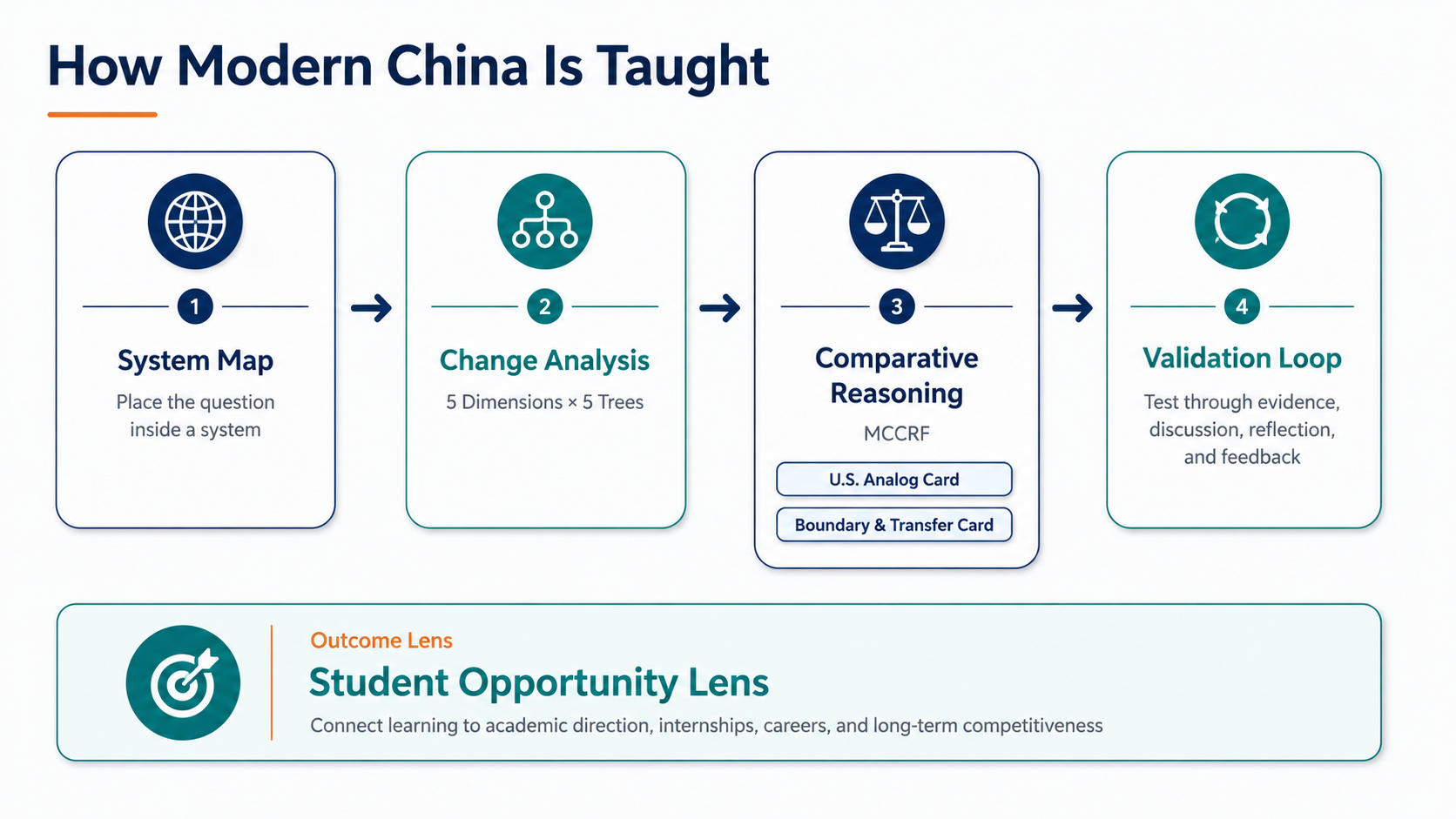
Modern China is taught through a structured learning method, not through headlines, opinions, or isolated case studies.
1. System Map
Students first learn to place a question inside a system. Using a System Map, they examine how national systems, infrastructure, cities, industries, companies, and markets connect.
2. Change Analysis / 5 Dimensions × 5 Trees
Students ask what changed, compared with what, in which part of the system, through what mechanism, and with what implications.
3. Comparative Reasoning / MCCRF
Students compare U.S. and China systems not to decide which side is “better,” but to understand mechanisms, constraints, tradeoffs, and transferability. Tools such as the U.S. Analog Card and Boundary & Transfer Card help students ask: What is the closest U.S. comparison? What can transfer? What cannot transfer? What must be adapted?
4. Validation Loop
Students test their analysis through source review, discussion, field questions, reflections, presentations, and feedback. Each topic must also connect back to a Student Opportunity Lens: what this system may mean for students’ academic direction, research interests, internships, career pathways, and long-term competitiveness.
This method turns Modern China from passive knowledge into a practical training process: students learn how to frame a question, compare systems, validate evidence, identify limits, and explain why the issue matters to their own future pathway.
What Students Gain
Modern China helps students build two advantages that matter more in the AI era:
Advantage 1
better understanding of modern China as a strategic knowledge advantage
Advantage 2
the AI-era ability to make sound judgments and deliver reliable outcomes
When this ability is exercised across national systems, it becomes Global Competence.
The first matters because modern China increasingly affects how industries evolve, where opportunities form, and how students think about future direction. At the same time, most U.S. schools still do not systematically teach modern China. As demand rises while structured supply remains limited, stronger understanding of modern China can become a real structural advantage for future pathways.
The second matters because AI is changing how success works — from mainly knowledge and skill toward judgment and execution. Yet most schools also do not systematically train the AI-era ability to make sound judgments and deliver reliable outcomes. In a more complex, faster-changing environment, students increasingly need stronger preparation in exactly this capability.
Together, these can support:
- clearer direction for majors and future careers
- stronger college application differentiation through visible analytical outputs
- better preparation for future work in high-complexity, AI-shaped environments
What Modern China Is Not
Modern China is not:
Instead, it treats China as a real-world system and uses structured comparison to train how students analyze systems, make sound judgments, and produce more reliable outcomes.
How It Fits in Global Competence | China Track
Within Global Competence | China Track:
Modern China provides the curriculum and knowledge foundation
SEE China serves as the field-training and validation layer in real-world systems
Together, they form a connected pathway for the Global Competence the AI era demands.

