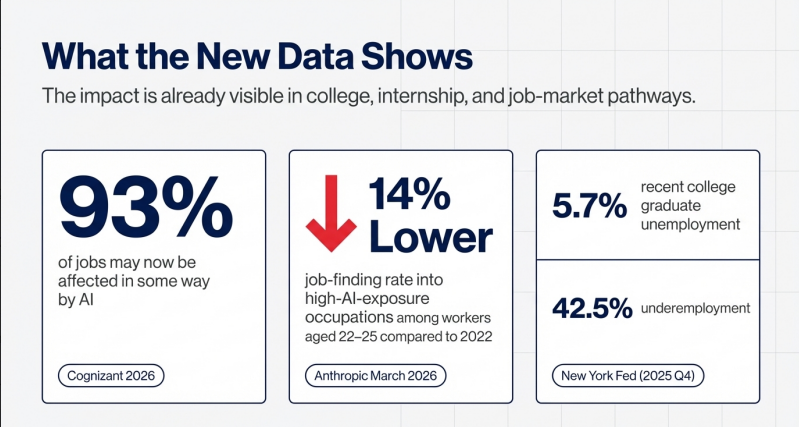
AI is already reshaping students' college, internship, and job-market pathways.
Part 1 of our SEE China Insights series explains the first major shift students and families need to understand in the AI era: AI changed the success formula.
AI is no longer just a future topic for students. It is already changing the environments they are preparing to enter. Recent data shows that AI is reshaping entry-level white-collar work at unprecedented speed, and that success is shifting from knowledge and skill toward judgment and execution. This article explains why that shift matters now, why many families can already feel it, and what students increasingly need beyond school knowledge.
AI is already reshaping students' college, internship, and job-market pathways
In April 2020, Youth4AM shared McKinsey research suggesting that nearly 50% of work activities could eventually be automated by AI. In August 2023, we also used Pew Research findings to urge students to prepare for the capabilities the AI era would require. Now the data shows clearly that AI is reshaping white-collar work at unprecedented speed, especially at the entry level. Leaders such as Jensen Huang, Sam Altman, Dario Amodei, and Satya Nadella have emphasized the same shift: in the AI era, what matters more is no longer only knowledge and skill, but judgment and execution. Those are exactly the core capabilities Youth4AM has been training since 2019.
So we are launching this series to explore a practical question with families and students: In the AI era, what do students need to stay competitive, why, and how? This is Part 1.
Recent data shows that AI is reshaping entry-level white-collar work at unprecedented speed
For families with students in upper high school or college, AI is no longer a future issue. It is already shaping the college, internship, and job market their children are about to enter.
Recent data makes that hard to ignore.
In January 2026, Cognizant estimated that 93% of jobs may now be affected in some way by AI.
In March 2026, Anthropic reported that among workers aged 22–25, the job-finding rate into high-AI-exposure occupations was 14% lower than in 2022.
The New York Fed also reported that by late 2025, unemployment among recent college graduates had risen to about 5.7%, while underemployment reached 42.5%.
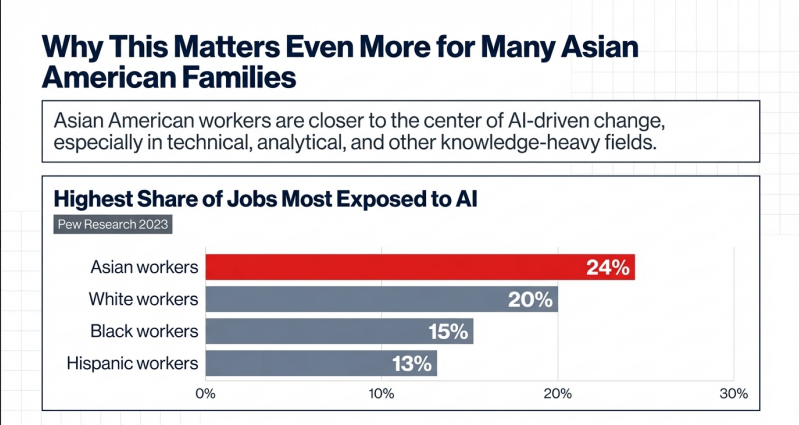
Why this matters even more for many Asian American families
This matters even more for many Asian American families, especially those closer to the center of AI-driven change in technical, analytical, and other knowledge-heavy fields. In 2023, Pew Research found that Asian workers had the highest share of jobs most exposed to AI: 24%, versus 20% for White workers, 15% for Black workers, and 13% for Hispanic workers.
So if your family feels that something fundamental has changed, that reaction is reasonable. AI is not simply technology advancing. It is structural change.
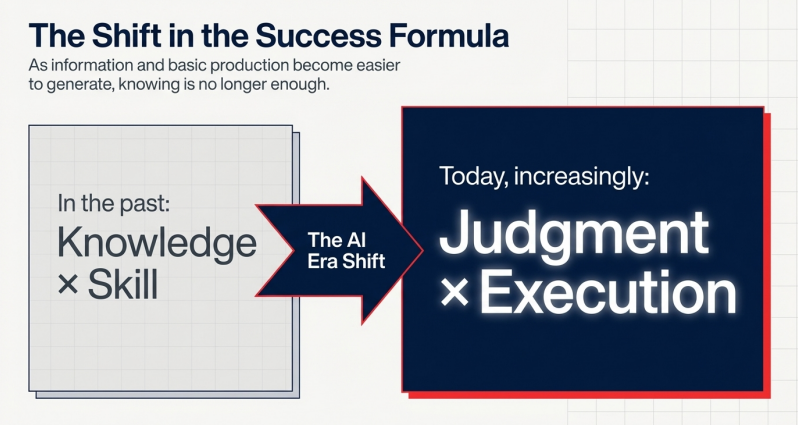
AI changed the success formula
In the past, success could be described more simply as:
Knowledge × Skill
Today, it is shifting more visibly toward:
Judgment × Execution
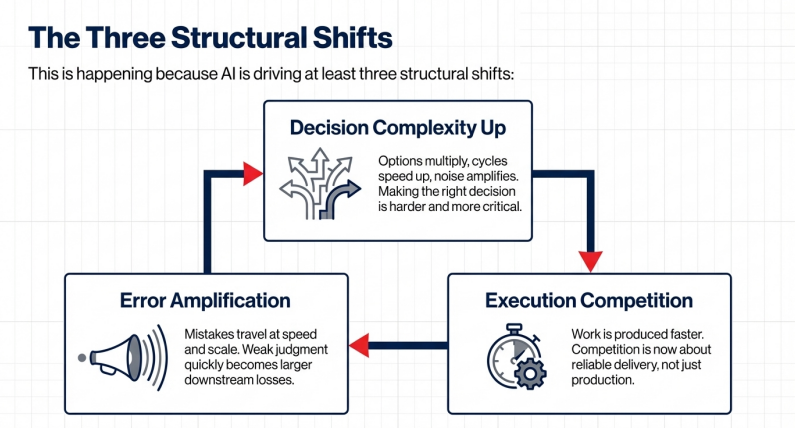
The structural shifts behind this change
Why is this happening?
Because AI is driving at least three structural shifts at once:
Decision Complexity Up
Knowing more becomes easier, but making the right decisions becomes harder and more important.
Execution Competition
Competition shifts from whether work can be produced to whether it can be delivered reliably.
Error Amplification
Weak judgment can quickly become weak strategy, weak actions, and larger downstream losses.
Together, these shifts point to one conclusion:
This is only the first structural shift.